table of contents
- Context: a real-world example
- Key challenges we see in stories like this
- How Humble Consultancy can help
- Typical outcomes we target
- Next steps for agencies and technologists like /u/GratefulDadHead
- How to engage Humble Consultancy
- Leave A Comment Cancel reply
- view related content
- Design Thinking for Nonprofits: Run a Process Mapping Workshop to Prioritize Automation and Data Projects
- Top 25 Nonprofit Automations for 2026: Low‑Cost Tools to Save Staff Time and Boost Impact
- Modernizing Blackbaud: Automations and Integrations to Make Raiser’s Edge and Luminate Work for Today’s Nonprofits
Context: a real-world example
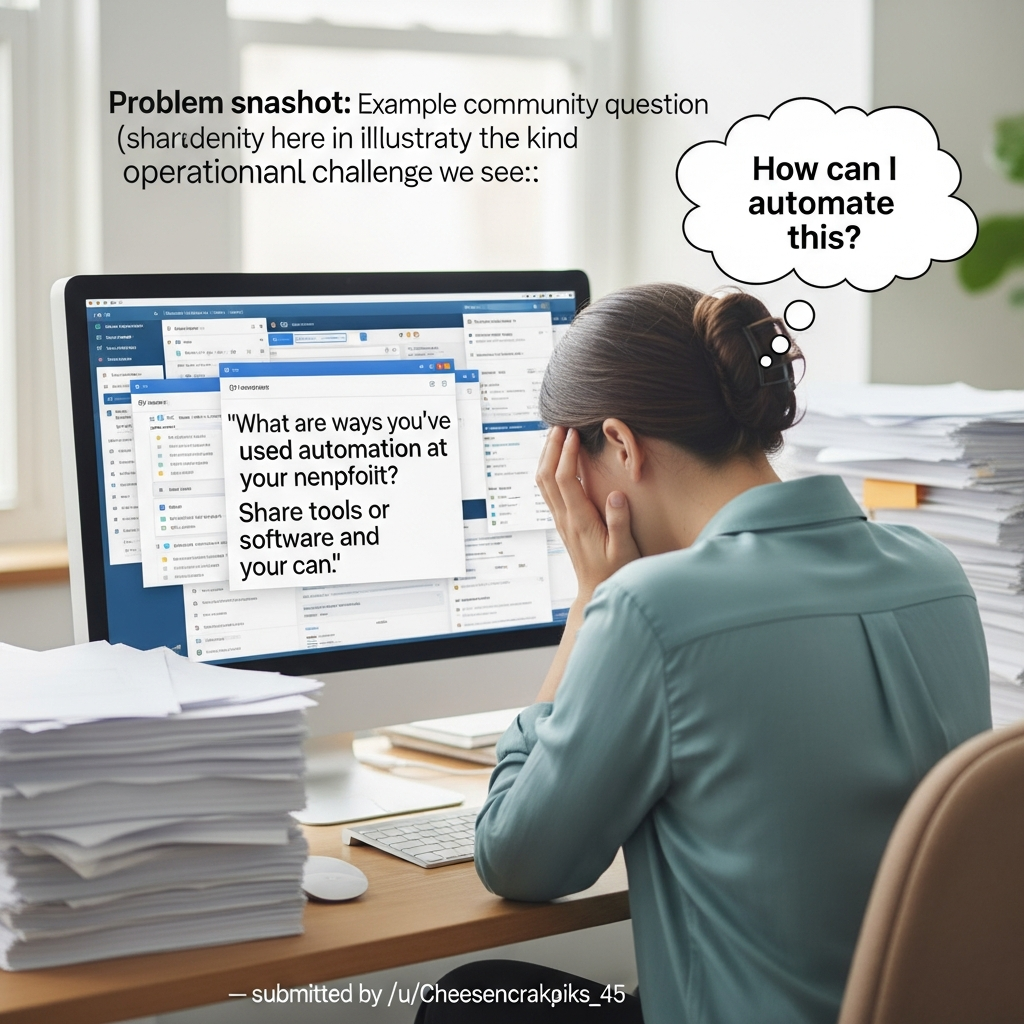
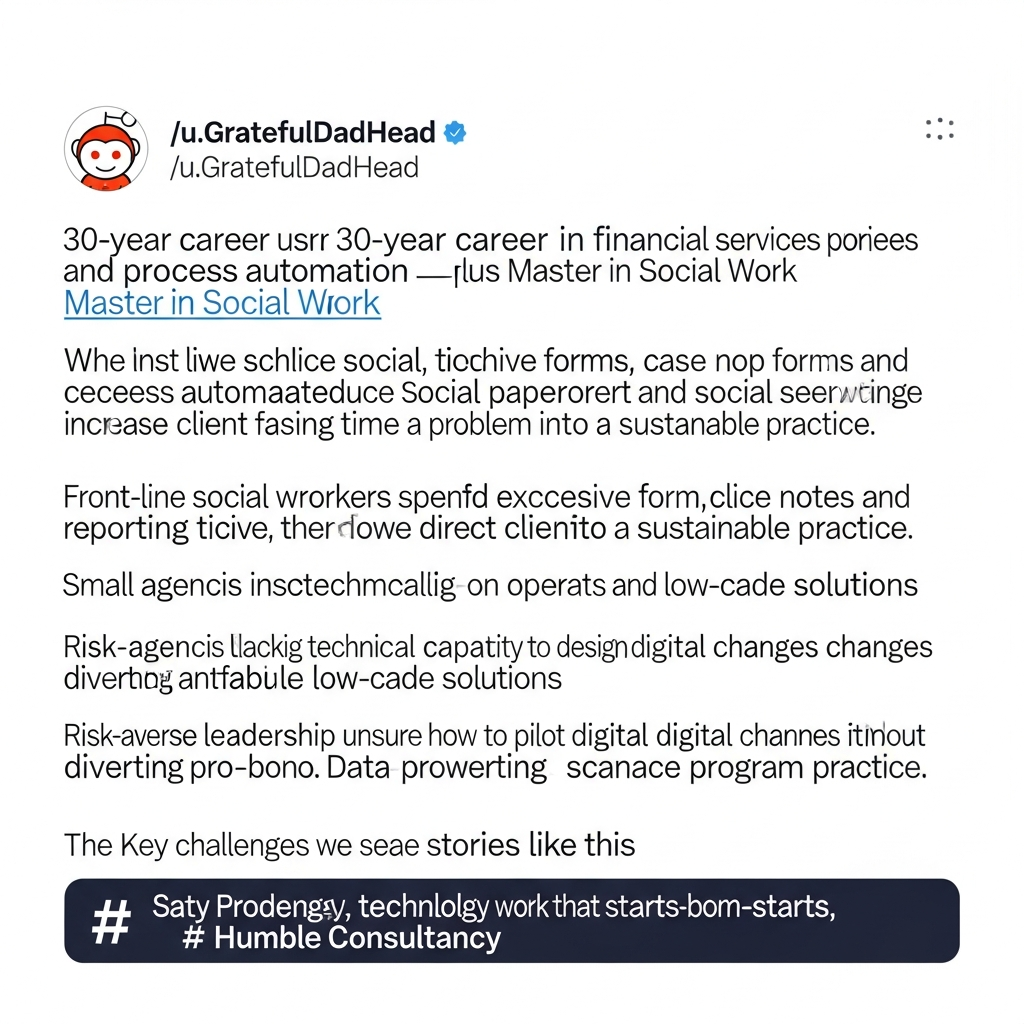
We were recently inspired by a post from Reddit user /u/GratefulDadHead, who described a 30-year career in financial services and process automation, plus a Master in Social Work, and a desire to pivot toward helping social service agencies reduce paperwork and increase client-facing time. The poster proposed starting pro-bono, then growing into a sustainable practice. That lived problem is exactly the kind of nonprofit challenge Humble Consultancy exists to solve.
Key challenges we see in stories like this
- Front-line social workers spending excessive time on forms, case notes and reporting rather than direct client care.
- Small agencies lacking technical capacity to design or operate reliable automation and low-code solutions.
- Risk-averse leadership unsure how to pilot digital changes without diverting scarce program resources.
- Funding and sustainability concerns for technology work that starts as pro-bono or grant-funded.
- Data privacy, compliance and ethical considerations when automating client-facing processes.
How Humble Consultancy can help
Humble Consultancy specializes in humane, high-impact AI and automation for nonprofits and social service organizations. We take examples like the one shared by /u/GratefulDadHead and convert them into low-risk, high-value change projects that prioritize mission impact over flashy technology.
1) Rapid discovery & alignment (2–4 weeks)
We begin with a focused, time-boxed discovery: observe workflows, interview staff, map handoffs and quantify time spent on paperwork vs. client work. Deliverable: a concise opportunities brief that identifies 2–3 high-impact automation pilots and clear success metrics (e.g., hours saved per caseworker per week; reduction in data entry errors; time-to-reporting).
2) Pro-bono pilot design and governance
For organizations with tight budgets, we design small, measurable pilots that can start pro-bono or with grant funding. Each pilot includes:
- Scope and acceptance criteria tied to mission outcomes
- Data privacy and consent guardrails
- A clear handoff plan so agency staff retain control after the pilot
3) Humane automation & low-code delivery
We favor low-code/no-code and human-centered AI where it reduces keystrokes and cognitive load without creating brittle systems. Typical solutions include:
- Form consolidation and smart templates to cut redundant fields
- Automated data routing to reduce manual copying between systems
- Document generation and scheduled reporting to relieve administrative burden
4) Training, documentation and capacity building
Technology projects fail when staff aren’t trained. We pair automation delivery with concise, role-based training, simple playbooks for common exceptions, and an internal “champion” training program so agencies can own and extend solutions.
5) Funding strategy & sustainability planning
If a pilot proves value, we help translate results into funding asks—grant applications, cost-sharing proposals, or a transition plan from pro-bono to a small subscription model that the agency can sustain. We emphasize transparency so leadership can see the path to long-term affordability.
6) Ethical & compliance review
Social service data is sensitive. We conduct a privacy and compliance review tailored to the agency’s jurisdiction and client population, and build technical controls (access roles, encryption, minimal data retention) into every automation.
Typical outcomes we target
- 3–8 hours saved per caseworker per week through streamlined intake and reporting
- Faster referral and follow-up times, improving client outcomes
- Cleaner, auditable data for funders and impact reporting
- Greater staff satisfaction as administrative burden decreases
Next steps for agencies and technologists like /u/GratefulDadHead
If you’re a social service organization, or a professional with complementary skills thinking about a shift into nonprofit-focused digital transformation, here are sensible next moves:
- Run a 2–4 week discovery to quantify the problem and identify one pilot.
- Start with pro-bono or grant-funded pilots that have clearly defined success metrics.
- Design for handover—ensure agency staff can run and extend the solution.
- Plan for ethical safeguards and sustainable funding from the outset.
How to engage Humble Consultancy
Humble Consultancy supports nonprofits through the whole lifecycle: discovery, pilot delivery, staff training and sustainability planning. We work collaboratively with subject-matter experts (including experienced practitioners who are transitioning from other sectors) to keep solutions practical and mission-centered.
If you want to explore a pilot or learn how to structure a pro-bono-to-sustainable program, reach out and we’ll schedule a concise discovery that fits your timeline and budget.