table of contents
- Problem snapshot
- Why this matters for nonprofits
- Common, high-impact automation opportunities
- Humble Consultancy’s humane, high-impact approach
- Typical tools and integration patterns we implement
- Quick starter roadmap for a pilot
- How Humble Consultancy can help
- Next steps
- Leave A Comment Cancel reply
- view related content
- Design Thinking for Nonprofits: Run a Process Mapping Workshop to Prioritize Automation and Data Projects
- Modernizing Blackbaud: Automations and Integrations to Make Raiser’s Edge and Luminate Work for Today’s Nonprofits
- Responsible AI in Grant Writing: How US Nonprofits Can Use ChatGPT Ethically Without Jeopardizing Funding
Problem snapshot
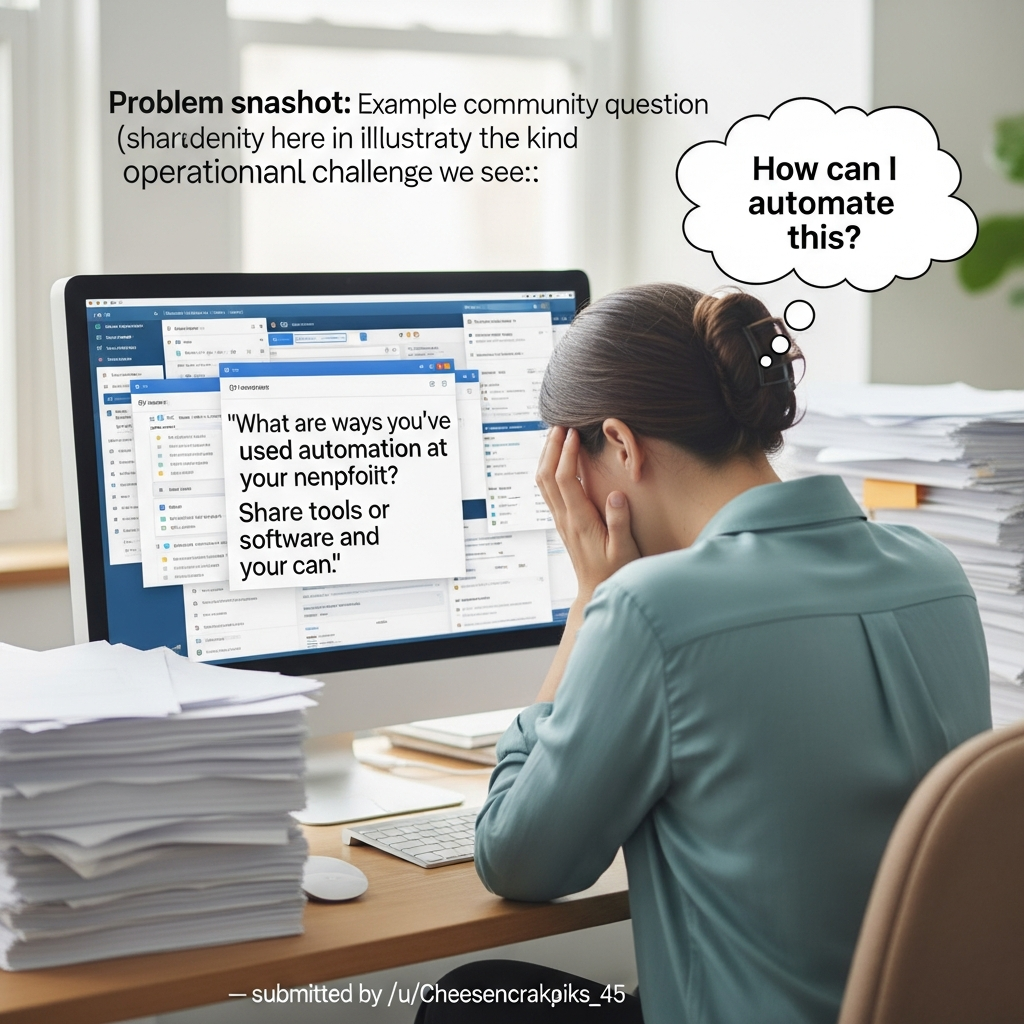
Example community question (shared here to illustrate the kind of operational challenge we see): “Hi all! What are ways you’ve used automation at your nonprofit? Share tools or software if you can.” — submitted by /u/Cheesencrackers_45
Why this matters for nonprofits
Small and midsize nonprofits often carry repeated, manual work across fundraising, volunteer coordination, client intake, and reporting. Those tasks drain staff time, limit capacity for mission-focused work, and make it hard to scale programs. Automation can help, but only when it’s designed to be humane (preserves dignity and staff expertise), low-risk, and aligned with fundraising and compliance realities.
Common, high-impact automation opportunities
- Donor stewardship workflows: automated thank-you emails, personalized touchpoints, and gift acknowledgements.
- Volunteer scheduling and reminders: signups, shift confirmations, and no-show follow-ups.
- Client intake and eligibility screening: online intake + conditional routing to staff for sensitive cases.
- Data hygiene and CRM syncing: deduplication, enrichment, and automated updates between tools.
- Grant tracking and reporting: deadline reminders, progress snapshots, and consolidated evidence packs.
- Program outcomes collection: automated surveys and dashboards that feed program reporting.
- Finance and expense automation: recurring invoice reconciliation, petty cash workflows, and approvals.
Humble Consultancy’s humane, high-impact approach
1) Discovery and stakeholder mapping
We start by listening to staff and volunteers. Instead of prescribing tools, we map who touches each process, what decisions are manual, and where automation would remove friction without removing human judgment—especially for client-facing and compliance-sensitive workflows.
2) Outcomes-first design
Every automation is built around a clear outcome (time saved, improved response time, increased donor retention) and measurement plan. We prioritize automations that return meaningful capacity for mission work and protect service quality.
3) Low-code, human-in-the-loop implementations
We favor low-code integrations and simple automations that non-technical staff can understand and adjust. Where decisions affect people, we design human-in-the-loop checks so staff remain the final arbiter. This reduces risk and improves adoption.
4) Data governance and accessibility
Automation increases data movement. We implement lightweight governance: consent mapping, access controls, retention rules, and documentation that helps auditors and funders understand flow and safeguards.
5) Coaching, templates, and capacity building
Rather than delivering a black-box solution, we provide templates, step-by-step runbooks, and staff training so teams can iterate independently. We also support grant language and budgets to help fund automation pilots.
Typical tools and integration patterns we implement
- CRM workflows (for example: donor acknowledgement and segmentation flows)
- Form-to-database intake + conditional routing (intake → triage → case worker)
- Calendar and scheduling automations tied to volunteer management
- ETL-style syncing for data hygiene between spreadsheets, CRMs, and reporting dashboards
- Automated reporting pipelines that consolidate outcomes for funder reports
Quick starter roadmap for a pilot
- Identify one repetitive pain-point that wastes staff time (e.g., donor thank-you process).
- Measure current time and error rates so you can quantify impact.
- Design a one-week pilot with a clear success definition.
- Implement a low-code automation with a human-in-the-loop step.
- Collect feedback, measure the savings, and iterate.
- Scale with governance and staff training once the pilot proves value.
How Humble Consultancy can help
We translate community questions like the one shared by /u/Cheesencrackers_45 into practical, low-risk pilots and long-term automation strategies. Our services for nonprofits include:
- Process discovery workshops tailored to staff capacity and mission priorities.
- Design and build of humane automations with human-in-the-loop controls.
- Data governance, consent mapping, and compliance checklists.
- Training, documentation, and templates so teams remain in control.
- Support with grant-ready language and project costing to fund pilots.
Next steps
If your nonprofit is asking the same question—“How can we use automation responsibly?”—start with one small pilot and measure the outcome. If you want help turning that pilot into an actionable plan, reach out to Humble Consultancy for a conversation about a discovery workshop or a low-cost pilot design. We focus on humane, high-impact automation that frees teams to do more mission work while protecting people and data.