
table of contents
- Context — an example problem from the field
- Key pain points we see in situations like this
- Risks and tradeoffs to be explicit about
- Practical options to consider
- Recommended roadmap (practical, nonprofit-focused)
- How Humble Consultancy can help
- Typical deliverables & timelines
- Final note — realistic expectations
- Leave A Comment Cancel reply
- view related content
- Design Thinking for Nonprofits: Run a Process Mapping Workshop to Prioritize Automation and Data Projects
- Top 25 Nonprofit Automations for 2026: Low‑Cost Tools to Save Staff Time and Boost Impact
- Modernizing Blackbaud: Automations and Integrations to Make Raiser’s Edge and Luminate Work for Today’s Nonprofits
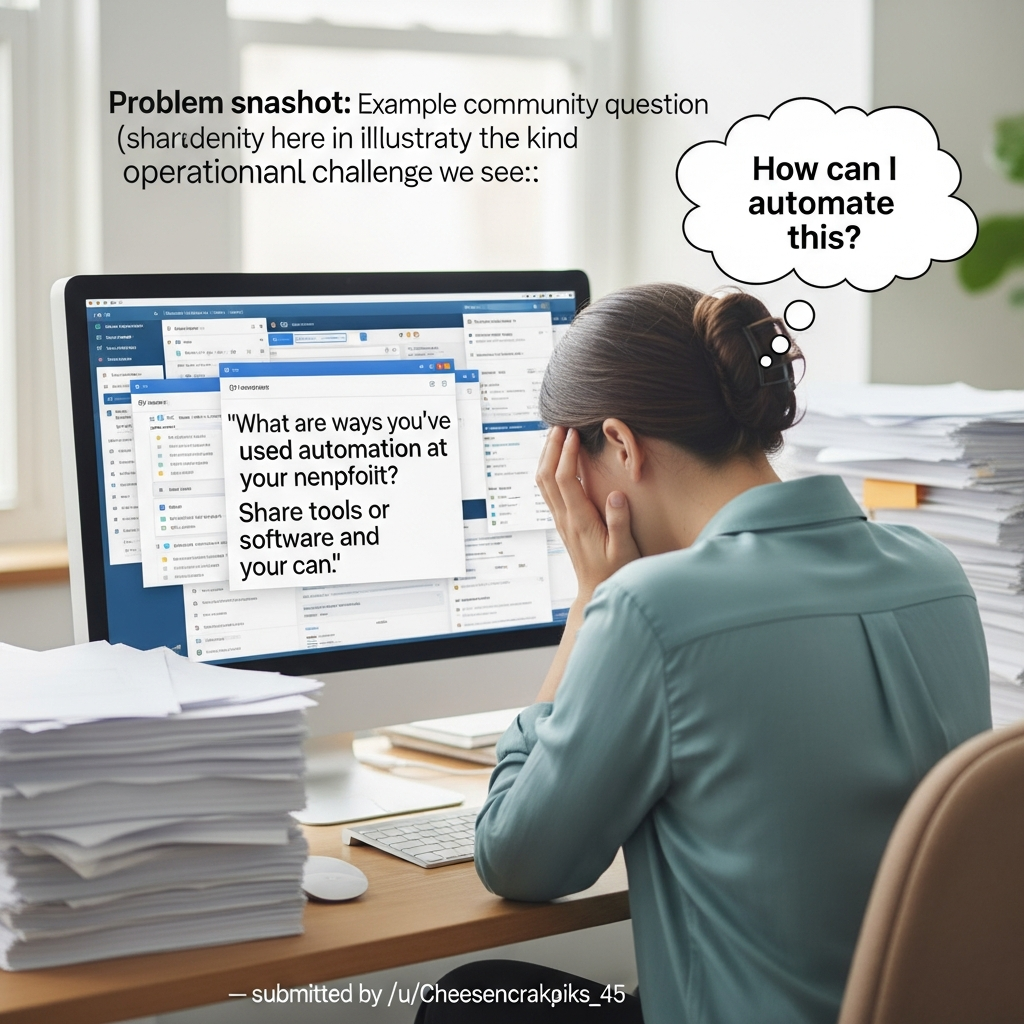
Context — an example problem from the field
As an example, Reddit user /u/ReluctantAlaskan described a real-world nonprofit struggle: their development office is using Blackbaud Raiser’s Edge with the Luminate module for social and online giving. The system feels outdated, clunky, and unintuitive to newer staff. Long, multi-step processes frustrate the team and make it hard to build simple digital campaigns. Because of Blackbaud’s market share and the perceived risk of data loss, ripping the system out isn’t seen as an option — though teams are interested in using tools like MailChimp if data can be reconciled back into Raiser’s Edge.
Key pain points we see in situations like this
- High friction for routine tasks — too many steps to build and launch digital campaigns.
- Poor usability for newer staff; knowledge concentrated in a few veteran users.
- Fear of data loss or corruption limiting innovation and experimentation.
- Integration gaps between WordPress, email tools (MailChimp), and Raiser’s Edge/Luminate.
- Limited automation and few intuitive templates for recurring campaign workflows.
- Unclear migration or sync strategy for modern marketing tools back into donor records.
Risks and tradeoffs to be explicit about
Before making changes, leadership should weigh:
- Operational risk of data migration or sync errors versus the cost of continued inefficiency.
- Training and change-management investment needed to modernize processes.
- Vendor lock-in realities — some functionality will require vendor-supported integrations or middleware.
- Short-term productivity dips during any transition versus long-term gains in capacity and donor experience.
Practical options to consider
1) Keep Blackbaud, reduce friction with smart augmentations
Make Raiser’s Edge and Luminate actually usable by layering automation, templates, and middleware rather than replacing the system.
2) Hybrid approach — best-of-breed email/marcom tools with controlled sync back
Use MailChimp (or another modern ESP) for campaign design and sending, and implement reliable bi-directional syncs so gift and engagement data flows into Raiser’s Edge for stewardship and reporting.
3) Full migration (only if justified)
Move to a modern CRM/engagement platform if Raiser’s Edge is demonstrably blocking strategic goals and the total cost of ownership (including migration, data clean-up, and retraining) makes sense. This is highest risk and highest effort.
Recommended roadmap (practical, nonprofit-focused)
- Week 0–2: Diagnostic audit — map current processes, identify 3–5 highest-friction campaign workflows, inventory integrations (WordPress forms, payment gateways, Mailchimp, Luminate, etc.).
- Week 2–4: Quick wins — build reusable templates, standard operating procedures, and one-click campaign starter kits inside the existing toolchain; implement a sandbox environment for safe testing.
- Week 4–8: Build automations & syncs — introduce middleware (Zapier/Make/Workato or a purpose-built connector) to reduce manual steps and set up reliable MailChimp ↔ Raiser’s Edge synchronization with reconciliation rules.
- Week 8–12: Staff enablement & governance — deliver role-based training, run playbook refreshers, and create a documented rollback/data recovery plan.
- Ongoing: Metrics & iteration — track campaign time-to-launch, email deliverability, online giving % of total donations, and donor journey metrics; iterate monthly.
How Humble Consultancy can help
We specialize in humane, high-impact AI and automation for nonprofits. For a situation like this, our engagements typically include:
- Operational audit and Opportunity Deep Dive — map systems, people, and processes; quantify time-savings and revenue upside from specific automations.
- Integration & data strategy — design a safe, reversible approach to syncing MailChimp (or another ESP), WordPress forms, and online giving back into Raiser’s Edge, including reconciliation rules, deduplication, and data validation.
- Automation design and implementation — implement middleware or light-weight custom connectors to remove unnecessary steps (campaign creation, donor tagging, gift attribution), and automate routine stewardship messages and donor acknowledgements.
- “Campaign factory” templates — create reusable campaign templates and short SOPs so non-technical staff can assemble compliant campaigns in minutes instead of hours.
- Training and change management — hands-on training sessions and a buddy/coach model to support older staff into new workflows without overwhelming them.
- Data safety & rollback planning — build sandbox tests, transactional logging, and a rollback plan to reduce perceived and real risk of data loss.
- Ongoing support & governance — help set up a lightweight governance model so new automations are reviewed, documented, and maintained.
Typical deliverables & timelines
- Opportunity Deep Dive report (2 weeks) — prioritized list of quick wins and ROI estimates.
- Implementation sprint (4–8 weeks) — connectors, templates, and 2–3 automations launched in production.
- Training + governance setup (2 weeks) — playbooks, recorded sessions, and an internal support plan.
Final note — realistic expectations
You’re not being a “silly millennial.” Many nonprofit systems were built for different decades and weren’t designed for rapid digital-first workflows. The right path usually isn’t an all-or-nothing rip-and-replace; it’s about lowering friction where it matters, protecting donor data, and empowering staff with safer, repeatable processes. If you’d like, Humble Consultancy can run a low-cost diagnostic for your team (including a three-issue quick-win plan mapped to Raiser’s Edge and your WordPress integration) so you can see concrete improvements within weeks, not months.
Example post used: /u/ReluctantAlaskan — thanks for sharing the challenge that inspired this Opportunity Deep Dive.