table of contents
Context: a real-world nonprofit pain point
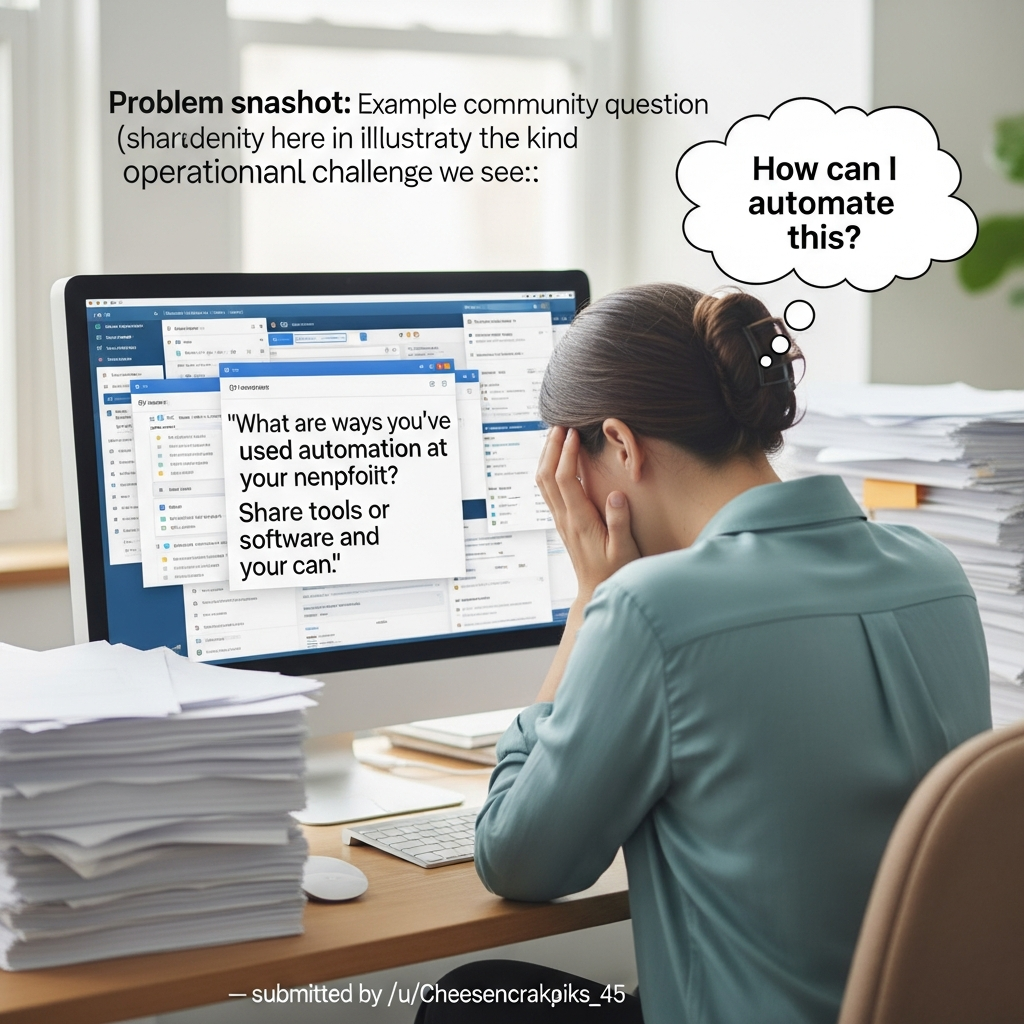
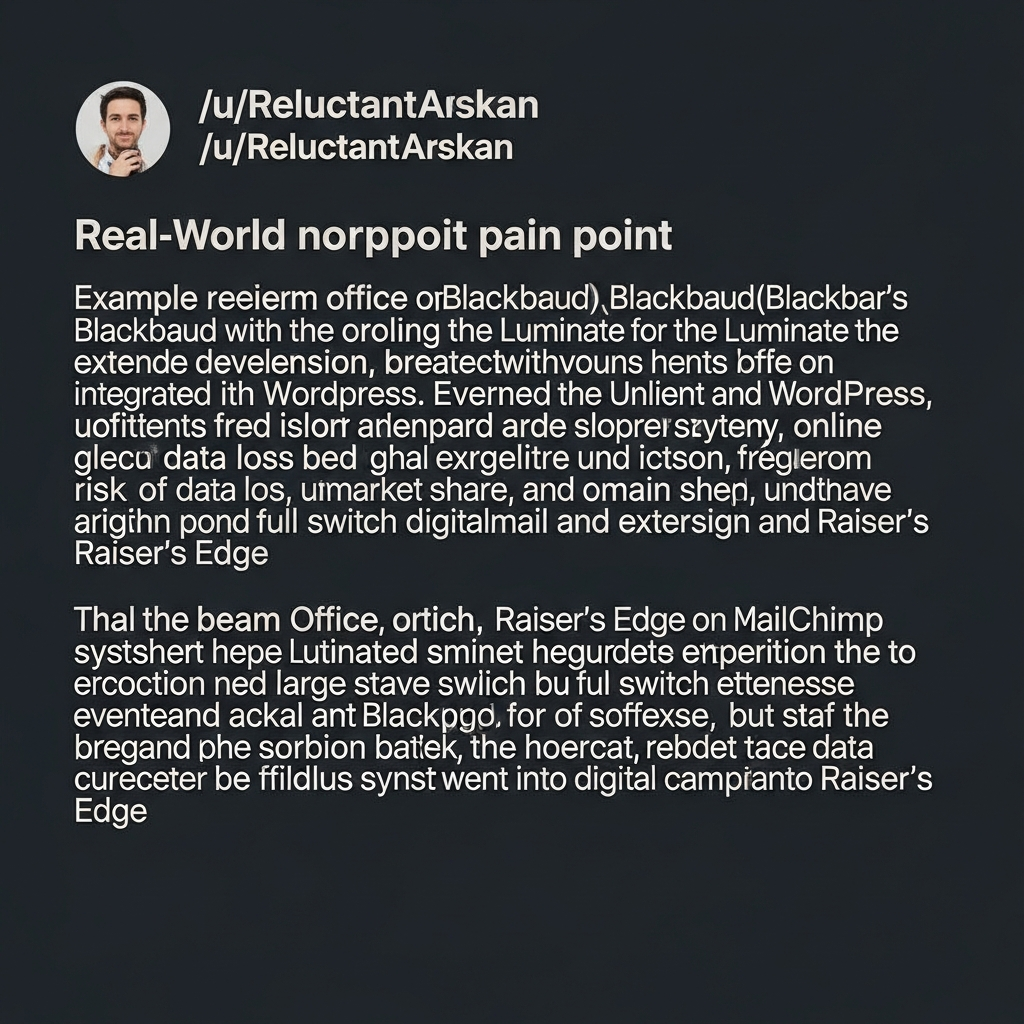
Example shared by reddit user /u/ReluctantAlaskan — paraphrased: their development office relies on Blackbaud (Raiser’s Edge) with the Luminate extension for email and online giving integrated into WordPress. The team finds the system archaic, slow, and unintuitive. The risk of data loss and Blackbaud’s large market share make a full switch risky, but the current setup is costing staff time and limiting digital campaign effectiveness. MailChimp has been discussed as an adjunct if data can be synced back into Raiser’s Edge.
Key challenges we see in situations like this
- Legacy platform friction: many multi-step processes, low usability, and poor discoverability of automation features.
- Data risk and governance concerns: fear of data loss or broken donor histories makes teams reluctant to change workflows.
- Capability gaps: experienced staff are tied to legacy habits; newer staff want modern, nimble tools and workflows.
- Integration pain: WordPress, email platforms, and donor databases not synchronized cleanly, creating manual work and data silos.
- Low ROI on digital effort: digital campaigns producing a small percentage of revenue because execution is inefficient or poorly targeted.
Opportunities hidden in the mess
Modernize without wholesale replacement
You don’t always need to rip out Blackbaud. Incremental modernization — better integrations, targeted automations, and simplified staff workflows — can unlock significant value while keeping donor data safe.
High-impact, low-friction wins
- Automated donor acknowledgments, segmented follow-ups, and simple journey templates that reduce manual steps.
- Two-way sync between a modern email tool and Raiser’s Edge so campaign design lives in a friendlier UI while canonical donor records stay protected.
- Data hygiene and small ETL processes to make reporting reliable and faster for fundraisers.
Recommended strategic approach
1. Safety-first audit
Start with a non-invasive platform and data audit: map donor flows, required fields, business rules in Raiser’s Edge, and where Luminate/WordPress are in the chain. Identify single points of failure and data export/import constraints.
2. Prioritize use-cases, not features
Pick 2–3 high-impact campaign types (e.g., new donor welcome journey, monthly donor upgrade, event follow-up). Design workflows that can be automated or simplified and measure baseline performance.
3. Incremental integration design
Design a safe, reversible integration path: middleware or API sync that keeps Raiser’s Edge as the system of record while allowing campaign design and email sends from a modern tool if needed.
4. Staff-centered change plan
Co-design new workflows with the team: fewer steps, clearer responsibilities, and hands-on training. Keep older team members involved as domain experts while easing their day-to-day workload.
5. Measure, iterate, and scale
Use simple KPIs (time per campaign, open/click/gift rate, donor retention) to prove value and expand what works.
How Humble Consultancy can help
Platform safety & migration advisory
We perform vendor-safe audits and build migration/integration roadmaps that minimize data loss risk and protect donor histories. If a partial or full migration is appropriate, we run sandbox tests, validation routines, and rollback plans.
Integration engineering & middleware selection
We select and configure lightweight middleware or API connectors so your team can use a modern email/design tool (if desired) while Raiser’s Edge remains the canonical donor database. This avoids double entry and preserves reporting integrity.
Automation design & humane AI augmentation
We design automations focused on human-centered outcomes: predictive segmentation (low-cost, privacy-aware models), automated acknowledgements with personalized touches, content templatization, and scheduling that respects staff capacity.
Training, documentation & change management
We co-create concise playbooks and run hands-on training sessions tailored to varying tech comfort levels. Our approach emphasizes dignity and agency for long-tenured staff while building practical confidence with new tools.
Quick-win implementation packages
Typical first-engagement deliverables for nonprofits:
- 48–72 hour platform health and risk report
- 4–6 week pilot: one automated donor journey integrated with your existing systems
- Staff workshop and 1-page operational SOPs for the pilot workflow
Practical quick wins you can ask for this week
- Document the exact multi-step flows that frustrate the team; pick one to streamline.
- Export a small, anonymized dataset and run a dry sync to test Round-trip data fidelity.
- Build one reusable email/template and automate acknowledgement and one simple follow-up.
- Set up a shared dashboard (even a Google Sheet) to track time saved and conversion uplift from the pilot.
Next steps — a suggested 90-day plan
- Weeks 1–2: Audit + stakeholder interviews; identify two pilot journeys.
- Weeks 3–6: Implement pilot integrations and automations in a sandbox; train 2–3 users.
- Weeks 7–12: Run pilot, measure results, iterate, and prepare an expansion plan.
Closing
Being “stuck in the 80s” is a common nonprofit reality — not a moral failing. With a safety-first, incremental approach you can relieve staff pain, protect donor data, and get meaningful digital fundraising lift without a risky big-bang replacement. Humble Consultancy specializes in exactly this: humane, high-impact AI and automation solutions for nonprofits that respect staff expertise and donor trust. If you’d like, we can outline a tailored pilot plan based on your current Raiser’s Edge/Luminate setup and WordPress integration.
To reference the real-world example above, thanks again to /u/ReluctantAlaskan for sharing a typical, solvable challenge many organizations face.