table of contents
- Context — an example from the field
- Common nonprofit challenges this question highlights
- Typical approaches: in-house vs. hiring consultants
- How Humble Consultancy can help — practical, nonprofit-first support
- Example outcomes we aim to deliver
- Next steps for nonprofits considering this work
- Leave A Comment Cancel reply
- view related content
- Design Thinking for Nonprofits: Run a Process Mapping Workshop to Prioritize Automation and Data Projects
- Top 25 Nonprofit Automations for 2026: Low‑Cost Tools to Save Staff Time and Boost Impact
- Modernizing Blackbaud: Automations and Integrations to Make Raiser’s Edge and Luminate Work for Today’s Nonprofits
Context — an example from the field
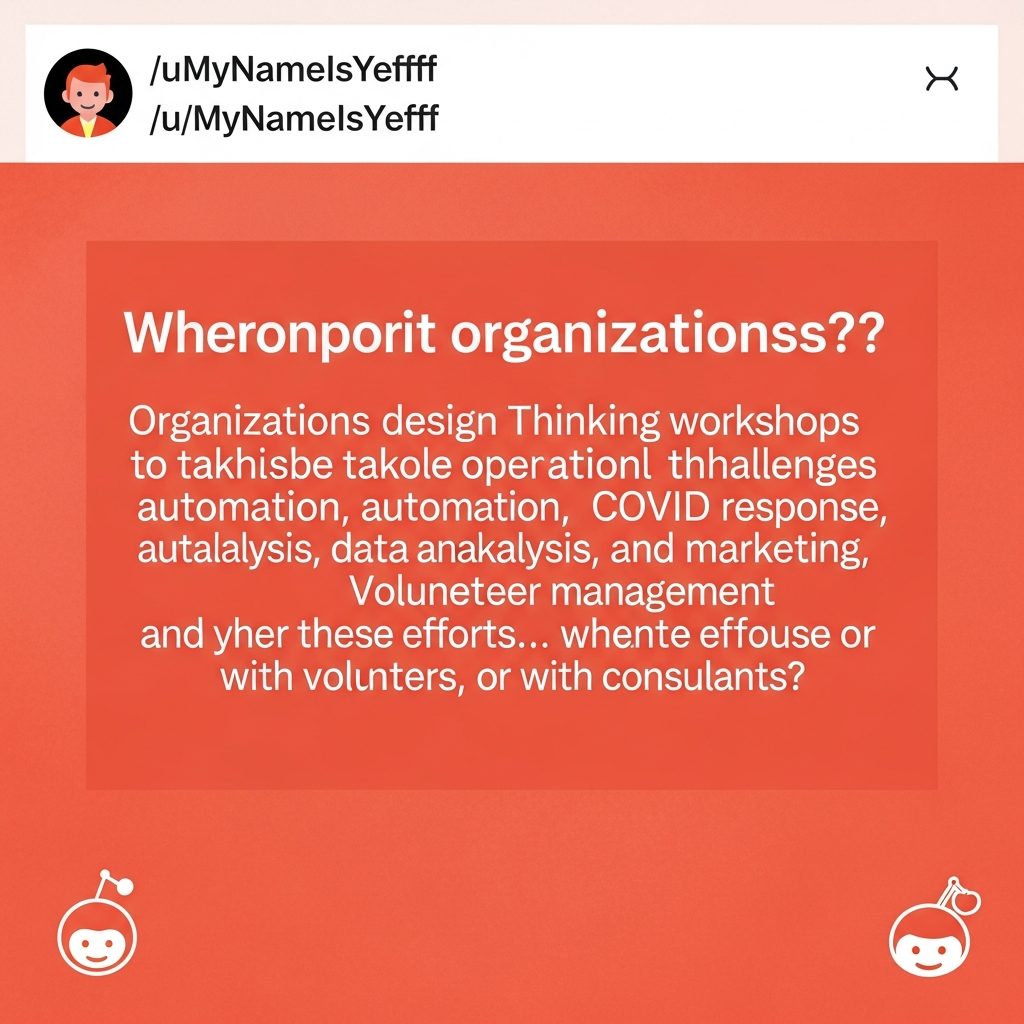
A nonprofit-focused Reddit post by /u/MyNameIsYeffff asked whether organizations are using design thinking workshops to tackle operational challenges like COVID response, automation, data analysis, marketing, and volunteer management — and whether those efforts are run in-house or with consultants. This is a common, practical question many small and mid-sized nonprofits face as they try to modernize without overstretching limited staff capacity.
Common nonprofit challenges this question highlights
Nonprofits frequently face the same cluster of problems that make innovation feel risky or out of reach:
- Unclear problem definitions that lead to misdirected projects.
- Limited staff time and diffuse capacity across programs and operations.
- Data trapped in spreadsheets or siloed systems, making analysis and automation hard.
- Difficulty translating strategic ideas from workshops into implementable plans.
- Concern about cost and ROI when hiring external consultants.
Typical approaches: in-house vs. hiring consultants
Both routes are used successfully, but they have trade-offs:
- In-house: Builds internal skills and institutional knowledge but can slow projects and overburden staff.
- Consultants: Bring focused expertise and speed, plus external perspectives; risks include poor knowledge transfer and solutions that aren’t fit-for-context.
Design thinking workshops are frequently part of both approaches, but their impact depends on follow-through: prototyping, resourcing, and implementation plans.
How Humble Consultancy can help — practical, nonprofit-first support
Humble Consultancy specializes in humane, high-impact AI and automation for nonprofits. We use design thinking as a means — not an end — to help organizations move from workshop insights to measurable outcomes without overburdening staff.
1) Problem framing & rapid discovery
We start by clarifying the right problem to solve so workshops produce usable outcomes. Typical steps:
- Stakeholder interviews and lightweight systems mapping.
- Goal alignment across program, ops, and leadership.
- Quick feasibility check for automation and data opportunities.
2) Facilitated design workshops with implementation pathways
Rather than one-off brainstorms, our workshops are built to generate specific, testable prototypes and a clear implementation roadmap. Deliverables include:
- Prioritized opportunity list with expected impact and effort estimates.
- Prototype concepts and success metrics (e.g., time saved, cost avoided, volunteer retention uplift).
- Concrete next-step plans for pilots, including owner and timeline.
3) Humane automation & data build-out
We design automation and AI solutions that are transparent, low-maintenance, and tuned to nonprofit realities:
- Automations that free staff from repetitive tasks (intake forms, scheduling, donor acknowledgements).
- Data pipelines and dashboards that make reporting and decision-making simple for non-technical users.
- Privacy- and mission-aligned AI features (e.g., text summarization for case notes, volunteer matching suggestions).
4) Implementation support and capacity building
We combine build work with training and handover so solutions stick:
- Phased implementation: pilot → iterate → scale.
- Staff training, written playbooks, and lightweight governance for ongoing maintenance.
- Options for fractional ongoing support to bridge capability gaps without permanent hires.
5) Engagement models tailored to nonprofits
We work in ways that respect limited budgets and the need for outcomes:
- Short discovery engagements to validate ideas before committing to builds.
- Modular projects (workshop + pilot + scale) so you pay for impact at each stage.
- Flexible pricing and partnership terms for mission-driven organizations.
Example outcomes we aim to deliver
- 30–60% reduction in staff time spent on repetitive administrative tasks through simple automations.
- Actionable dashboards that cut reporting time from days to hours and improve program decision-making.
- Volunteer workflows that increase retention and reduce onboarding burden.
- Replicable workshop-to-pilot pipeline that lets organizations iterate affordably.
Next steps for nonprofits considering this work
If your organization — like the one described by /u/MyNameIsYeffff — is evaluating design thinking and wondering whether to do this in-house or hire help, a low-risk discovery engagement is a practical next step. It gives you a clear answer on what’s worth investing in and how much internal vs. external effort will be required.
Humble Consultancy partners with nonprofits to run those discoveries, facilitate outcome-oriented workshops, and build the humane automation and data tools that make lasting change possible. If you want a short template for running your own discovery or a sample workshop agenda tailored to nonprofits, we can provide that as a next step.