
table of contents
- Context — a real-world example
- Key problems identified
- How Humble Consultancy can help
- Suggested implementation roadmap (nonprofit-friendly)
- Costs & equipment (high-level, nonprofit-focused)
- Privacy, security & audit readiness
- Why this matters for volunteer-run nonprofits
- Next steps
- Leave A Comment Cancel reply
- view related content
- Design Thinking for Nonprofits: Run a Process Mapping Workshop to Prioritize Automation and Data Projects
- Top 25 Nonprofit Automations for 2026: Low‑Cost Tools to Save Staff Time and Boost Impact
- Modernizing Blackbaud: Automations and Integrations to Make Raiser’s Edge and Luminate Work for Today’s Nonprofits
Context — a real-world example
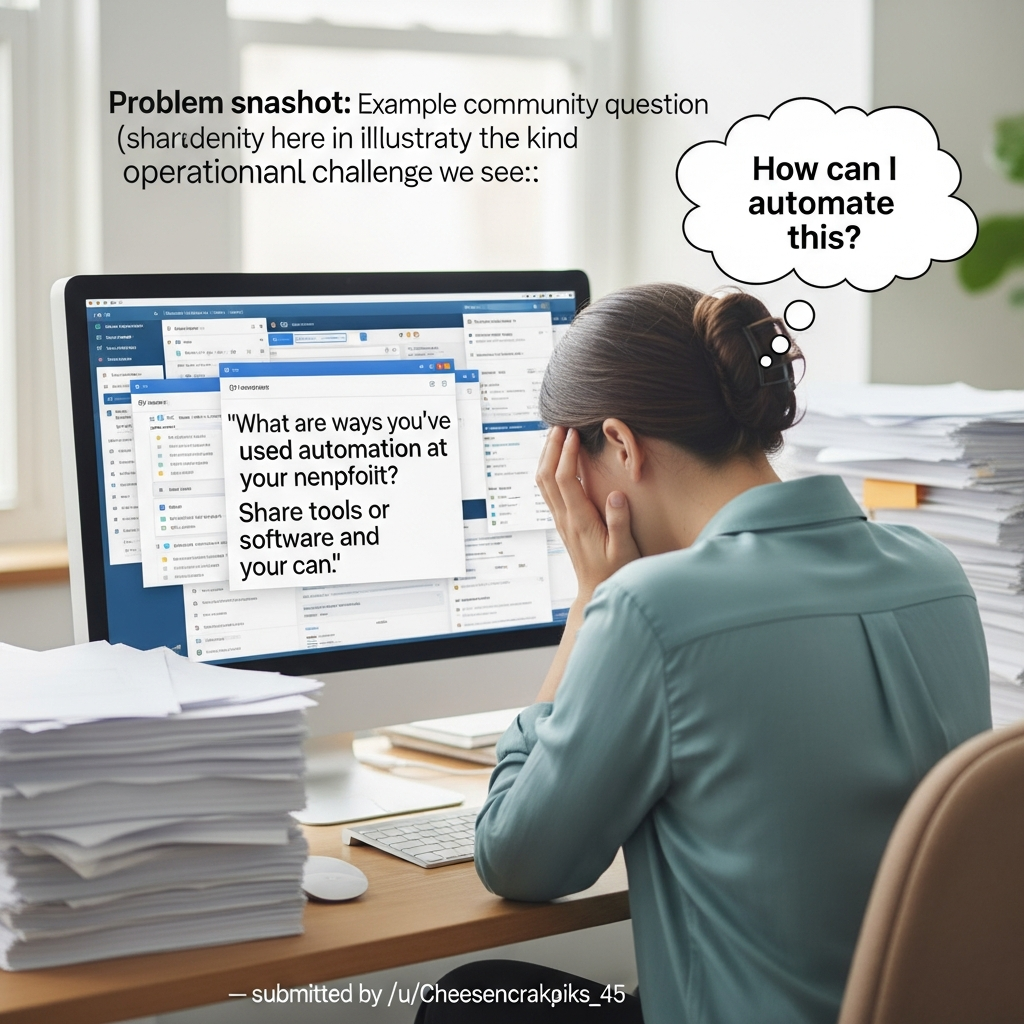
TLDR: A volunteer treasurer (submitted by /u/Emergency_Chair1493) inherited carbon-copy donation receipt books that were routinely lost, inconsistently completed, and manually re-keyed into Excel at tax time. That approach produced a weak audit trail, repeated work, and past audit trouble. Using simple API automation, they linked the POS to a centralized donation spreadsheet and an automated email system that issues an official tax receipt to donors within seconds — removing the need for physical books and removing single-person dependence.
Example reference: submitted by /u/Emergency_Chair1493
Key problems identified
- Paper carbon-copy receipt books distributed among volunteers are easily lost, misfilled, or hoarded when volunteers leave.
- No consistent reconciliation process — manual re-keying into Excel introduces errors and duplicate work (3–4x effort).
- Poor audit trail and previous audit findings related to donation receipting.
- Existing POS should generate receipts but doesn’t in practice — creating a need for a robust workaround.
- Resistance to change from long-tenured volunteer directors is a major adoption risk.
How Humble Consultancy can help
1) Build a humane, low-friction technical solution
We design automation that removes manual steps while respecting volunteer capacity and donor privacy. Typical approach:
- Capture donations at the point of sale (tablet/kiosk) into a centralized ledger (Airtable, Google Sheets, or a low-code CRM such as CiviCRM or Little Green Light).
- Use lightweight automation (Make, Zapier, or direct API integration) to create donor records and generate standardized tax receipts as PDFs.
- Send receipts automatically via email (SendGrid, Amazon SES, or native SMTP) and store an immutable archive copy in cloud storage (Google Drive/AWS S3) for audit support.
- Generate a tamper-evident audit trail by recording transaction IDs, user IDs, timestamps, and hash metadata alongside stored PDFs.
2) Restore internal controls & reconciliation
We implement simple, sustainable controls that volunteers can follow without financial expertise:
- Standard operating procedures (SOPs) for receipting, deposits, and monthly reconciliation.
- Role-based access controls so only authorized users can edit finance records.
- Automated daily reconciliation reports that flag mismatches between POS, bank deposits, and the donation ledger.
- Archiving and retention policies that meet local regulatory and audit requirements.
3) Change management tailored for volunteers
Technical fixes fail without people acceptance. We design a rollout and training program focused on volunteers:
- Stakeholder workshops to show time savings, reduced audit risk, and simple demos of the tablet workflow.
- Pilot program with a small group of volunteers to prove out the workflow and collect feedback.
- Clear one-page job aids, short recorded walkthroughs, and in-person/virtual training for all users.
- Governance checklist for board approval and an adoption champion to drive early wins.
Suggested implementation roadmap (nonprofit-friendly)
- Week 0–1 (Quick wins): Audit current POS capabilities, map donor data fields, and set up a central ledger prototype.
- Week 2–4 (MVP): Implement integration (Zapier/Make or API), automatic receipt template, and email delivery. Test with a tablet and 10–20 transactions.
- Week 5–6 (Pilot): Run pilot at selected events or locations, collect feedback, and tune templates, wording, and controls.
- Week 7–10 (Rollout): Full rollout, volunteer training, and enable audit archiving and reconciliation reporting.
- Ongoing (Governance): Quarterly control reviews, yearly audit prep checklist, and periodic training refreshers.
Costs & equipment (high-level, nonprofit-focused)
- Hardware: A basic tablet in kiosk mode ($100–$300) — single purchase per donation point.
- Software: Low-code integrations (Zapier/Make) and cloud storage — often $0–$50/month for small nonprofits.
- Labor: One-time setup by a consultant (Humble Consultancy) plus a half-day of volunteer training; reduced ongoing volunteer hours because of automation.
Privacy, security & audit readiness
We prioritize minimizing donor PII exposure and meeting audit expectations:
- Collect minimal PII necessary for tax receipts and use secure transport/storage (TLS, encrypted storage).
- Scoped access and MFA for finance/admin accounts.
- Audit-ready exports (CSV/PDF) with immutable timestamps and storage backups.
Why this matters for volunteer-run nonprofits
Small organizations with limited staff shouldn’t be dependent on paper books or particular volunteers. Humane automation removes repetitive tasks, reduces risk of audit findings, preserves institutional knowledge, and protects donors — all while being low-cost and reversible if needed.
Next steps
If your nonprofit is wrestling with paper receipts, error-prone reconciliations, or volunteer turnover, Humble Consultancy can:
- Run a free 30–60 minute diagnostic call to map your current flow and quick wins.
- Deliver an implementation proposal with a clear pilot plan, cost estimate, and training materials.
We use nonprofit-friendly pricing and focus on solutions that reduce volunteer burden while improving compliance and donor trust.