table of contents
- Context
- Common nonprofit automation opportunities
- Tools & platforms commonly used (examples)
- How Humble Consultancy approaches this problem
- Typical outcomes and ROI
- Next steps for nonprofits reading /u/Cheesencrackers_45’s question
- Final note
- Leave A Comment Cancel reply
- view related content
- Design Thinking for Nonprofits: Run a Process Mapping Workshop to Prioritize Automation and Data Projects
- Top 25 Nonprofit Automations for 2026: Low‑Cost Tools to Save Staff Time and Boost Impact
- Modernizing Blackbaud: Automations and Integrations to Make Raiser’s Edge and Luminate Work for Today’s Nonprofits
Context
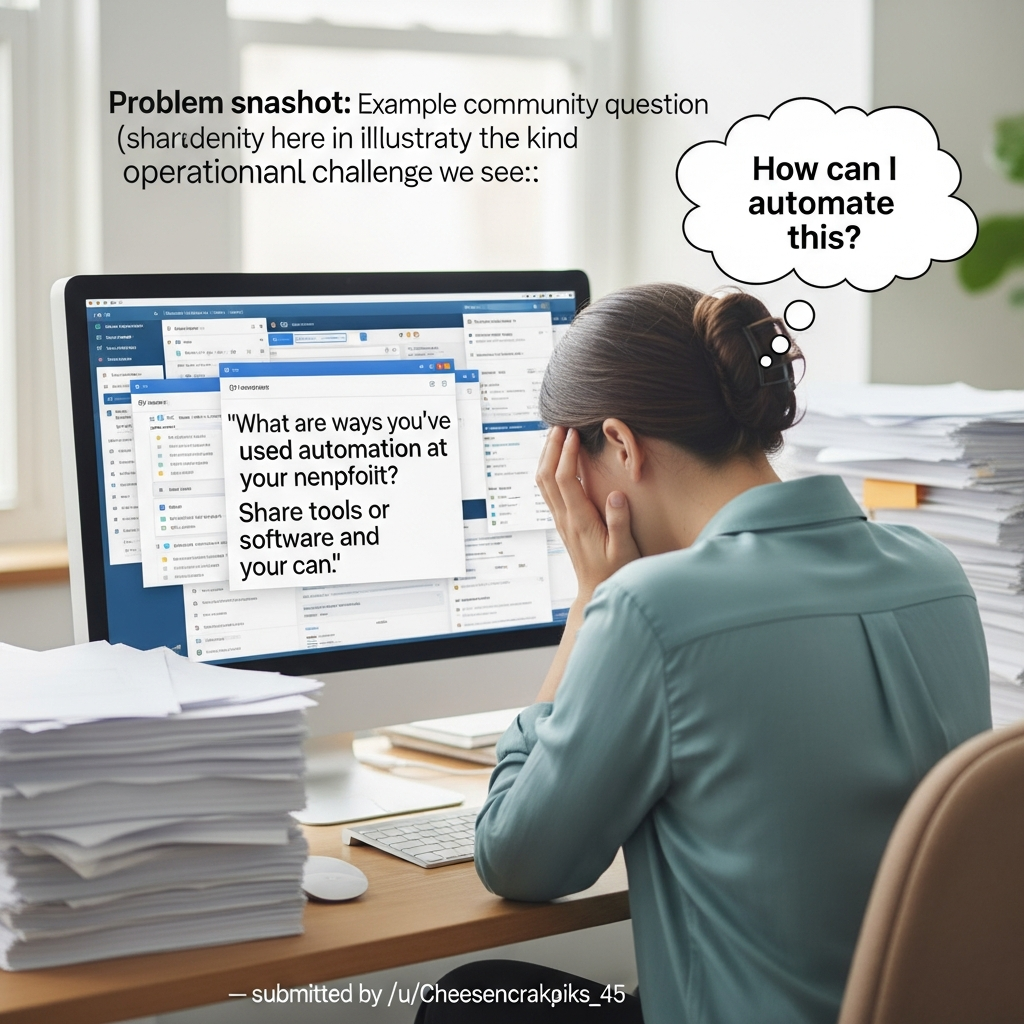
/u/Cheesencrackers_45 asked on Reddit: “Hi all! What are ways you’ve used automation at your nonprofit? Share tools or software if you can.” That short question is a useful real-world example of a common problem: well-meaning staff with overloaded schedules want practical, low-risk ways to use automation but don’t know where to start.
Common nonprofit automation opportunities
Below are humane, high-impact automation use cases we see again and again in small-to-medium nonprofits. Each focuses on reducing repetitive work, improving donor/beneficiary experience, and protecting staff time.
- Donor communications — automated thank-you receipts, recurring-gift processing, stewardship journeys that trigger based on donation amount, source, or anniversary.
- Volunteer onboarding & scheduling — forms + automated confirmations, reminders, background-check status updates, and capacity-based shift fills.
- CRM & data hygiene — deduplication, enrichment (e.g., append publicly available org data), and automated syncs between finance, email, and program systems.
- Grant tracking — deadline reminders, document collection workflows, and status boards to reduce missed opportunities.
- Event registration & logistics — auto ticketing, attendee reminders, badge printing prep, and post-event feedback workflows.
- Intake and case management — secure online intake forms, automated triage emails, and routing to the right caseworker based on criteria.
- Reporting & KPIs — scheduled dashboards, automated monthly reports, and alerts when key metrics cross thresholds.
- Legacy system automation (RPA) — lightweight robots for copying data from legacy desktop apps to modern systems when APIs aren’t available.
Tools & platforms commonly used (examples)
Different nonprofits will choose different stacks depending on budget, staff skill, and privacy needs. Examples we often recommend or integrate with:
- CRMs: Salesforce NPSP, CiviCRM, Bloomerang
- No-code automation: Zapier, Make (Integromat), Power Automate
- Forms & databases: Google Forms + Sheets, Typeform, Airtable, KoboToolbox
- Email & marketing: Mailchimp, Action Network, Emma
- RPA & scripting: UIPath (small bots), Google Apps Script
- Collaboration: Slack, Microsoft Teams, Notion
How Humble Consultancy approaches this problem
1. Opportunity Deep Dive (discovery)
We begin with a focused, nonprofit-tailored discovery session to map current workflows, pain points, and compliance constraints. Deliverables:
- Prioritized list of 5–8 automation opportunities with estimated impact (time saved, risk reduced) and level-of-effort.
- Data privacy and accessibility considerations for each opportunity.
2. Pilot design and rapid prototyping
We build small, low-risk pilots that deliver measurable value within 4–8 weeks. Pilots are configured to be human-friendly and reversible so staff can validate benefits without long-term commitment.
- Example pilot: automated donation receipts + donor acknowledgement sequence that reduces manual receipt time by 60%.
- Example pilot: volunteer shift-booking workflow that cuts scheduler time by half and reduces no-shows via SMS reminders.
3. Implementation with people-first change management
We deploy solutions using low-code tools your team already understands where possible, train staff, and build simple documentation. Our goal is sustainable adoption, not black-box automation.
4. Measurement & iteration
Each automation includes KPI tracking so you can see real operational improvements (hours saved, fewer errors, faster response times). We iterate once measurement validates impact.
Typical outcomes and ROI
- Reduce recurring administrative hours by 20–60% depending on scope.
- Faster donor acknowledgements and higher donor retention from prompt, personalized stewardship.
- Improved case response times and fewer missed grant deadlines.
- Lower burnout for frontline staff through elimination of repetitive tasks.
Next steps for nonprofits reading /u/Cheesencrackers_45’s question
If your organization wants practical help turning that Reddit question into a clear plan, Humble Consultancy can run an Opportunity Deep Dive tailored to your programs and systems. The Deep Dive gives you a prioritized roadmap (no hard sell) with one or two actionable pilot recommendations your team can approve.
To start, you can request a short exploratory conversation with us: Humble Consultancy. If you prefer email, reach out at [email protected] to describe one manual process you’d like to automate and we’ll propose next steps.
Final note
The most effective nonprofit automations are small, staff-centered, and measurable. Use /u/Cheesencrackers_45’s question as a prompt: pick one repetitive task, map it, and test a low-cost automation. If you want help at any step, Humble Consultancy specializes in building humane, high-impact solutions that respect staff capacity and beneficiary dignity.