
table of contents
- Overview
- Common automation opportunities for nonprofits
- Tools and platform types we see working well for nonprofits
- How Humble Consultancy can help
- Typical outcomes for nonprofits
- Next steps
- Leave A Comment Cancel reply
- view related content
- Design Thinking for Nonprofits: Run a Process Mapping Workshop to Prioritize Automation and Data Projects
- Top 25 Nonprofit Automations for 2026: Low‑Cost Tools to Save Staff Time and Boost Impact
- Modernizing Blackbaud: Automations and Integrations to Make Raiser’s Edge and Luminate Work for Today’s Nonprofits
Overview
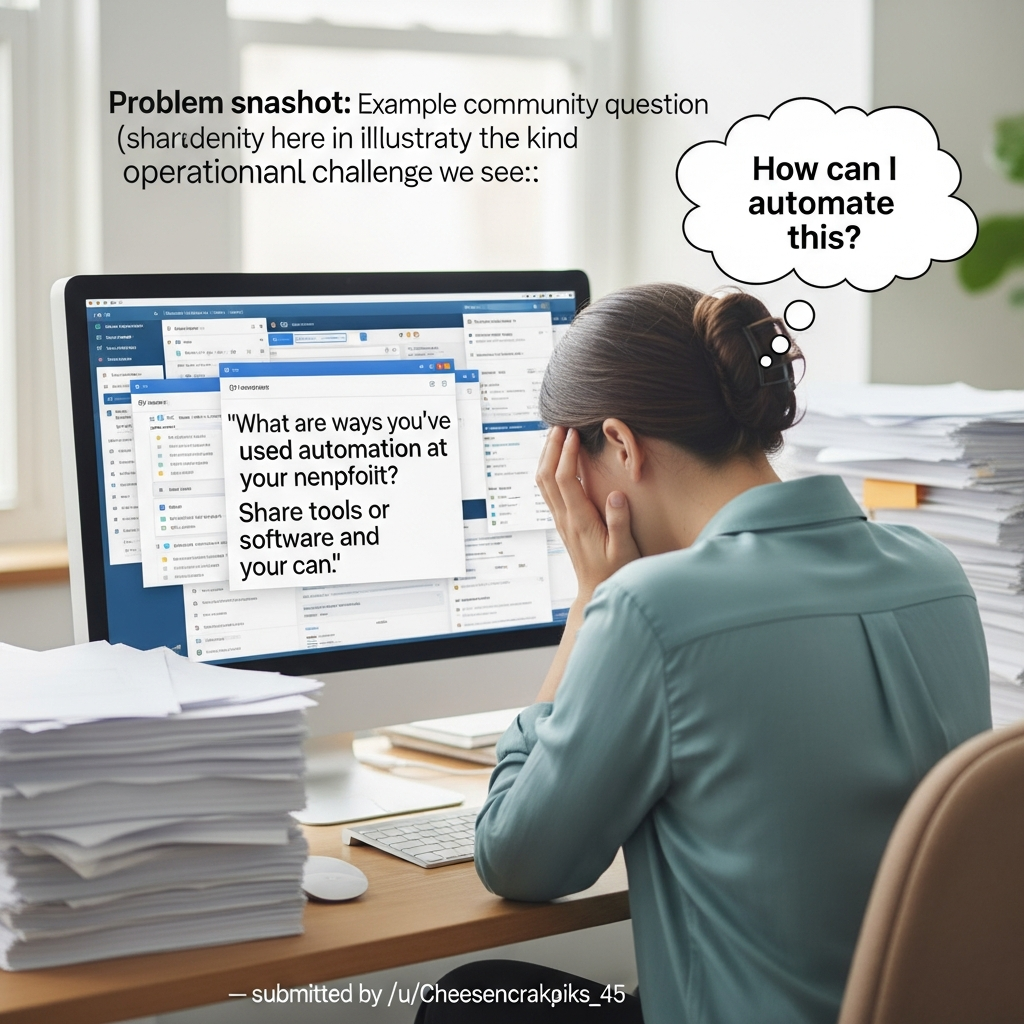
Nonprofit staff often ask practical, open-ended questions about automation. For example, a Reddit user raised this prompt:
Example: question from /u/Cheesencrackers_45
“Hi all! What are ways you’ve used automation at your nonprofit? Share tools or software if you can.”
That short, real-world question illustrates a common challenge: teams know automation could help, but they don’t have a clear, low-risk path to discovery, prioritization, and implementation that fits nonprofit budgets and values.
Common automation opportunities for nonprofits
- Donor and constituent communications (segmented email flows, SMS reminders, stewardship automation)
- Intake and case management (form-to-database workflows, automated triage, appointment scheduling)
- Fundraising operations (gift processing, matching gift checks, acknowledgement workflows)
- Program reporting and data aggregation (automated dashboards, periodic report generation)
- Volunteer coordination (registration, shift notifications, credentialing reminders)
- Grant tracking and compliance (deadline reminders, document collection, status updates)
- Back-office efficiencies (expense approvals, invoicing, HR onboarding)
Tools and platform types we see working well for nonprofits
- Low-code automation builders (Zapier, Make/Integromat, Microsoft Power Automate) for connecting apps quickly
- Constituent Relationship Management systems (CRM) built for nonprofits (e.g., Salesforce Nonprofit Cloud, Bloomerang, DonorPerfect)
- Form and intake platforms (Typeform, Google Forms, JotForm, Airtable forms) paired with automation layers
- RPA and robotic automation for repetitive desktop tasks where APIs don’t exist
- Business intelligence and dashboarding (Google Data Studio, Tableau, Power BI) for automated reporting
- Email/SMS engagement platforms (Mailchimp, SendGrid, Twilio) for segmented outreach automation
How Humble Consultancy can help
We use humane, mission-aligned automation practices designed for nonprofits that need measurable impact without over-automation or risk. Below are the core services we deliver, anchored around opportunity discovery and practical implementation.
1. Opportunity Deep Dive
We run a focused workshop and audit to turn questions like /u/Cheesencrackers_45’s into a prioritized automation roadmap. Deliverables include:
- Process maps of 3–5 candidate workflows
- Time, cost, and error baseline estimates
- Prioritized backlog with quick wins and strategic projects
2. Pilot & Proof of Value
We implement one high-value pilot (3–8 week sprint) to prove ROI and surface change-management needs. Pilots are scoped for low disruption and clear metrics (time saved, errors reduced, donor response uplift).
3. Implementation & Integration
For approved projects, we handle tool selection, build, testing, and deployment. Responsibilities we commonly take on:
- API-based integrations and secure data flows
- Template builds for automation workflows and campaign orchestration
- End-user training, documentation, and job aids
4. Governance, Ethics & Sustainability
We help nonprofits adopt guardrails that match their mission: data privacy and consent, bias mitigation, and maintenance plans so automations remain transparent and correct over time.
5. Capacity Building & Handoff
We prioritize staff empowerment: bite-sized training, playbooks for updates, and a prioritized maintenance backlog so your team can sustainably own automations after handoff.
Typical outcomes for nonprofits
- Immediate time savings for program and admin staff, freeing capacity for mission work
- More reliable and timely donor stewardship, improving retention and gift processing speed
- Faster, less error-prone reporting to funders and boards
- Lower operational risk through documented, governable automation
Next steps
If your team resonates with the example question from /u/Cheesencrackers_45 and wants a low-friction way to explore automation, Humble Consultancy can run a no-surprise Opportunity Deep Dive tailored to your program and tech stack. The Deep Dive gives a prioritized plan, pilot scope, and cost estimate so you can decide with confidence.
To start, gather 1–2 examples of repetitive tasks (e.g., donor acknowledgements, intake forms, volunteer scheduling) and we’ll convert them into a short discovery agenda you can run with your team.