table of contents
Context — example from /u/Effective-Cry-1332
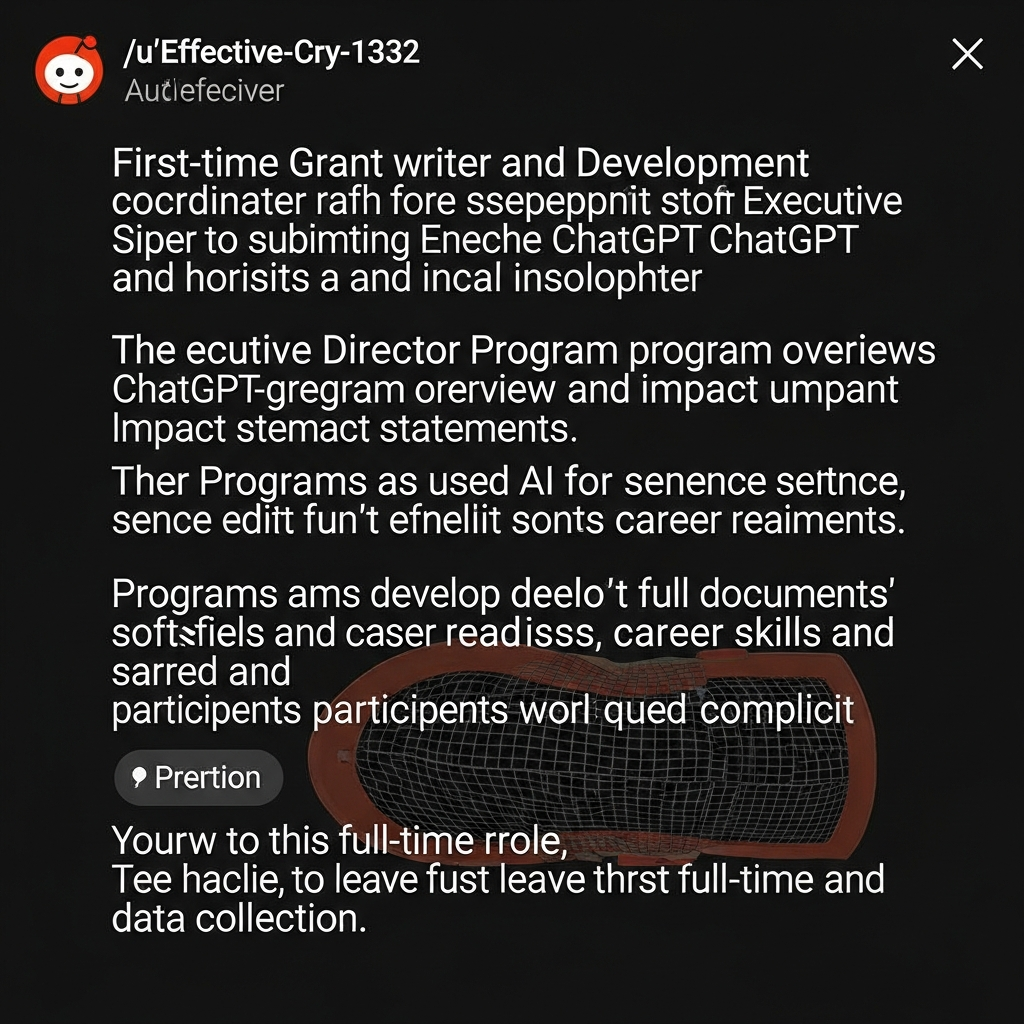
A recent Reddit post from /u/Effective-Cry-1332 describes a first-time grant writer and development coordinator at a small nonprofit who suspects the executive director has been submitting ChatGPT-generated program overviews and impact statements. The staff member has used AI for sentence edits but finds full documents that don’t reflect the organization’s real impact. Their programs aim to develop participants’ soft skills and career readiness. They’re hesitant to leave this first full-time role but feel complicit and want to push for better data collection.
Key problems this example highlights for small nonprofits
- Unclear or missing primary data on program outcomes (especially for soft skills).
- Overreliance on AI-generated content without local evidence or attribution.
- Capacity gaps in basic monitoring, evaluation, and grant-quality storytelling.
- Ethical and reputational risk when applications describe impact that can’t be validated.
- Staff retention and career risk concerns for early-career staff who discover these issues.
Recommended next steps — practical, nonprofit-focused
1) Fast triage (first 2 weeks)
- Document what exists: collect the program overview, recent applications, and any source documents the ED provided.
- Start a simple evidence log: one Google Sheet or Airtable table with fields for activity, participant counts, data source, and date.
- Ask for permission to run a short, non-confrontational data check: review a small sample of past applications and note where claims lack local evidence.
2) Establish three practical KPIs (30 days)
For soft-skills and career-readiness programs, choose easy-to-measure indicators such as:
- Participation and retention rate (attendance over program length).
- Skill improvement using a short pre/post self-assessment (3–6 items aligned to learning objectives).
- Outcome rate: number/percent of participants with a verified next step within X months (job, internship, training, or placement).
3) Low-cost measurement tools and methods (30–60 days)
- Use short pre/post surveys (Google Forms, Typeform) with Likert-style items that map to soft skills.
- Collect employer or mentor feedback via a 3-question survey after placements.
- Record 1–2 short participant stories (consented, 3–4 sentences) to triangulate quantitative data.
- If possible, add a simple participant ID so cohort-level outcomes can be tracked without complex systems.
4) Governance, transparency, and ethics (ongoing)
- Create a short AI-use policy: what is acceptable (editing, grammar, templates) and what requires local attribution or verification (impact narratives, data claims).
- Institute a rule that all grant statements of impact must be backed by a named source (survey, attendance sheet, employer verification, or a dated case note).
- Train staff on how to responsibly use AI: as a drafting tool, not a substitute for local evidence.
How Humble Consultancy can help
Humble Consultancy specializes in humane, high-impact AI automation for nonprofits. Using the example above, we can help your organization in practical, low-cost ways that protect reputation and strengthen fundraising.
Our service offerings tailored to this problem
- Grant materials audit — we review recent applications and program overviews to identify unverifiable claims and show exactly what needs evidence.
- Impact measurement starter kit — a 30–60 day package that sets up simple KPIs, pre/post instruments, and a one-sheet data-collection workflow your team can maintain.
- AI ethics & usage policy workshop — co-create a short policy and staff guidelines so AI helps, not hurts, credibility.
- Capacity-building training — hands-on sessions for development and program staff on collecting, interpreting, and using participant data for grants.
- Templates & automation — reusable grant language templates that tie statements directly to your local evidence, plus light automations (forms → spreadsheet → dashboard) to reduce administrative burden.
- Grant review and editing — we edit submissions to ensure claims are backed by evidence and optimize narrative flow for funders.
Suggested 30/60/90 day action plan (example)
- 30 days: Complete triage, set up one-sheet evidence log, deploy a 5-question pre/post survey for the next cohort.
- 60 days: Produce a short impact summary (quant + 1–2 stories) tied to evidence; present results to the ED and board with a recommended AI policy draft.
- 90 days: Implement policy, adopt 3 KPIs across programs, and automate basic reports for grant applications.
On the ethical and career angle
Using AI to polish language is common and acceptable when the factual claims reflect your own data. Systematically submitting unverified, AI-generated impact claims is a reputational risk for the organization and for the person submitting the application. If you’re worried about your resume or being a whistleblower, focus first on constructive, documented attempts to improve measurement and transparency—those steps protect you and strengthen the organization.
Next step
If you’d like a practical starting point, Humble Consultancy can run a 60–90 minute diagnostic call for your team to:
- Review one recent grant application for evidence gaps.
- Outline a simple KPI set and data-capture approach you can implement in 2–4 weeks.
- Provide a template AI-use policy draft and a short script for staff conversations about AI and evidence.
Contact Humble Consultancy to schedule a diagnostic consult and get a no-nonsense, nonprofit-first plan to replace guesswork with verifiable impact.