table of contents
- Opportunity overview
- Common nonprofit automation opportunities
- How Humble Consultancy approaches these problems
- Quick wins for small teams
- Responsible and humane automation
- Estimated timeline & resourcing
- Next steps
- Leave A Comment Cancel reply
- view related content
- Design Thinking for Nonprofits: Run a Process Mapping Workshop to Prioritize Automation and Data Projects
- Top 25 Nonprofit Automations for 2026: Low‑Cost Tools to Save Staff Time and Boost Impact
- Modernizing Blackbaud: Automations and Integrations to Make Raiser’s Edge and Luminate Work for Today’s Nonprofits
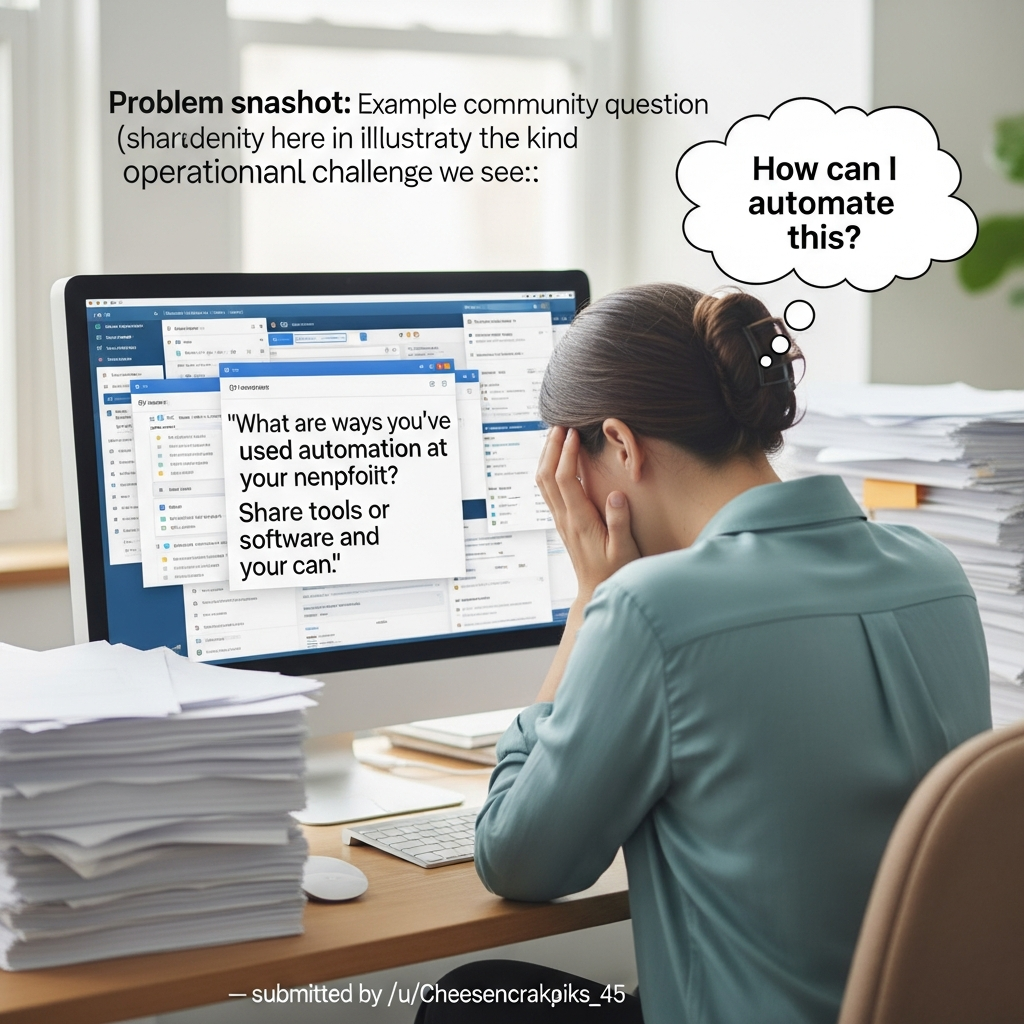
Thanks to /u/Cheesencrackers_45 for the prompt: “Hi all! What are ways you’ve used automation at your nonprofit? Share tools or software if you can.” Below is an Opportunity Deep Dive that uses that real-world question as an example of the kinds of problems Humble Consultancy helps nonprofits solve. This is written for nonprofit leaders, program managers, and operations teams who want humane, high-impact automation—not as a reply for the original poster.
Opportunity overview
Many small and mid-sized nonprofits ask the same question: how can we get routine, time-consuming work off staff plates so they can focus on mission-critical work? Automation—applied thoughtfully and ethically—can reduce administrative burden, improve data quality, increase donor and volunteer responsiveness, and make reporting easier without replacing people. Humble Consultancy specializes in designing automations that respect staff expertise, donor privacy, and organizational values.
Common nonprofit automation opportunities
Donor stewardship and fundraising
- Automatic thank-you and receipt emails after gifts, with personalized messaging based on gift size or campaign.
- Automated donor segmentation and engagement triggers (e.g., move to stewardship track after first gift).
- Tools commonly used: Salesforce Nonprofit Cloud, HubSpot for Nonprofits, Airtable.
Volunteer coordination
- Automated sign-up confirmations, shift reminders, and follow-up surveys to improve retention.
- Simple scheduling integrations between calendars, forms, and SMS or email reminders.
- Tools commonly used: Zapier, Make (Integromat), Google Workspace for Nonprofits.
Program intake, eligibility, and case management
- Form intake -> auto-routing to caseworker, plus automated resource-packets and next-step instructions for clients.
- Data validation and enrichment to reduce manual clean-up before reporting or referrals.
- Tools commonly used: CiviCRM, Airtable, low-code platforms.
Operational reporting and grant compliance
- Automated dashboards that refresh with program metrics and financials for funder reports.
- Scheduled exports and formatted reports to meet grant deliverable deadlines.
- Tools commonly used: Microsoft Power Automate, Zapier, business intelligence tools.
How Humble Consultancy approaches these problems
We use a pragmatic, human-centered process that minimizes risk and maximizes value for nonprofits:
- Discovery (1–2 weeks): Quick audit of workflows, systems, and data to find the highest-impact, lowest-risk automation candidates.
- Prioritization workshop: Rank opportunities by impact, feasibility, equity, and staff capacity.
- Prototype or pilot (4–6 weeks): Build a lightweight, testable automation with real users and measurable success criteria.
- Implementation & training: Deploy the solution, train staff, and document changes to keep knowledge in-house.
- Measure & govern: Set monitoring, privacy guardrails, and a roadmap for iterative improvements.
Quick wins for small teams
- Auto-send donor receipts and assign stewardship tasks in your CRM.
- Turn form submissions into calendar events + reminders for volunteers.
- Automate weekly program metric extracts into a single dashboard for leadership.
- Use simple integrations (Zapier or Make) to link existing tools before investing in big migrations.
Responsible and humane automation
Automation should amplify human work, not de-skill staff or marginalize clients. Key guardrails we implement:
- Data minimization and privacy-by-design for client and donor records.
- Human-in-the-loop checks for decisions that affect services or eligibility.
- Transparent documentation so staff understand what automations do and why.
- Training and role adjustments so teams keep agency over automated tasks.
Estimated timeline & resourcing
- Discovery + prioritization: 1–3 weeks (small orgs).
- Pilot automation: 4–6 weeks for a single workflow.
- Scale across an organization: 3–6 months depending on systems and data readiness.
- Typical team involvement: part-time ops/IT lead + 1–2 program staff for testing; Humble Consultancy provides design and delivery.
Next steps
If your nonprofit is wondering, like /u/Cheesencrackers_45, how to start using automation responsibly, Humble Consultancy can help you:
- Run a one-week intake to identify 1–3 high-impact automations.
- Deliver a pilot that proves value and reduces staff time spent on routine tasks.
- Provide training, documentation, and governance templates so automations are sustainable.
To explore a tailored approach for your organization, email us at [email protected] to schedule a short intake conversation.