table of contents
- Context and core problem
- Key risks nonprofits should recognize
- Immediate, low-effort actions for the staff member
- Operational fixes that prevent future problems
- How Humble Consultancy can help
- Suggested next steps for the Reddit poster (and similar staff)
- Why this matters for small nonprofits
- Leave A Comment Cancel reply
- view related content
- Design Thinking for Nonprofits: Run a Process Mapping Workshop to Prioritize Automation and Data Projects
- Top 25 Nonprofit Automations for 2026: Low‑Cost Tools to Save Staff Time and Boost Impact
- Modernizing Blackbaud: Automations and Integrations to Make Raiser’s Edge and Luminate Work for Today’s Nonprofits
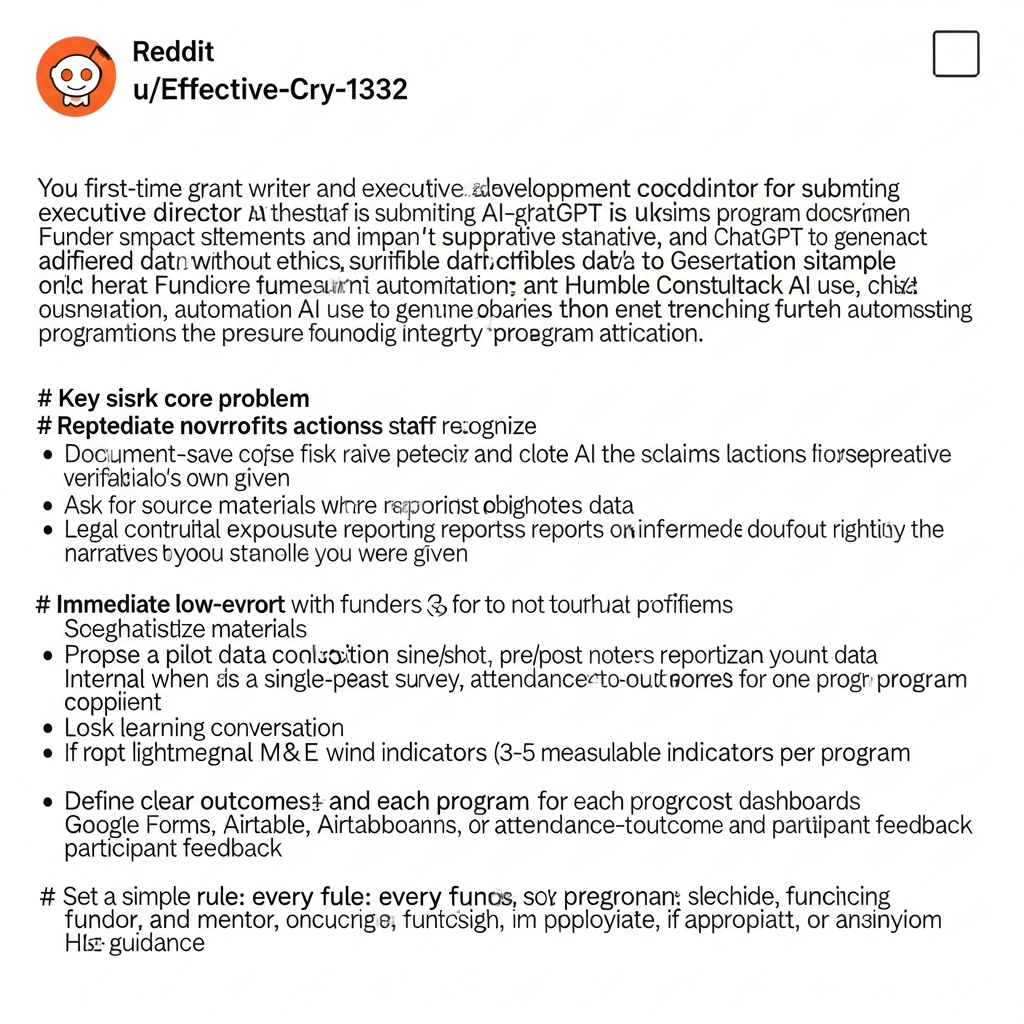
Using a recent Reddit post from /u/Effective-Cry-1332 as an example, this post outlines practical, nonprofit-focused steps for when staff discover leadership is using ChatGPT or other AI to generate funder-facing impact documents without solid supporting data or attribution. It also explains how Humble Consultancy can help organizations move from patchwork AI use to humane, verifiable automation that strengthens fundraising integrity and program outcomes.
Context and core problem
The situation described by the Reddit user: a first-time grant writer and development coordinator suspects the executive director is submitting AI-generated program overviews and impact statements that aren’t supported by the organization’s own data. The staff member feels complicit and unsure how to act, and rightly worries about ethics, funder expectations, and career risk.
Key risks nonprofits should recognize
- Reputational risk with funders if claims are not verifiable.
- Legal or contractual exposure where reporting obligations require accurate data.
- Internal trust breakdown when staff feel unable to surface problems.
- Lost learning opportunity: the organization misses chances to measure and improve programs.
Immediate, low-effort actions for the staff member
- Document—save copies of the suspicious documents and note where text mirrors AI output (date-stamped files help).
- Ask for source materials—politely request the raw data, evaluation notes, or previous reports that informed the narrative you were given.
- Propose a pilot data collection—suggest a single, short pre/post survey or attendance-to-outcome tracking for one program cohort.
- Seek a confidential conversation—if you feel unsafe, reach out to a mentor, a funding contact (if appropriate), or an anonymous HR/advice line for guidance.
Operational fixes that prevent future problems
- Define clear outcomes and indicators for each program (3–5 measurable indicators per program).
- Adopt lightweight M&E tools—Google Forms, Airtable, or low-cost dashboards to capture attendance, skill assessments, and participant feedback.
- Set a simple evidence rule: every funder-facing claim must cite a source (data, case study, or external research) and be tagged in the grant draft.
- Create an internal review workflow for all grant text that includes a verification step before submission.
- Formalize an AI use policy that explains when AI drafting/editing is acceptable and requires human verification and attribution.
How Humble Consultancy can help
Rapid integrity audit
We perform a short, practical assessment of recent grant materials, reporting, and program documents to identify unsupported claims, duplication, and AI-generated text patterns. Deliverable: an evidence gap map that shows which claims are verifiable and which need data or revision.
Build a lightweight M&E system
We design and implement low-cost monitoring systems tailored to small nonprofits—simple outcome indicators, one-page logic models, short survey instruments, and an Airtable or Google Sheets template that feeds a basic dashboard. Deliverable: a working data collection pilot and instruction pack staff can use immediately.
Ethical AI policy and staff training
We help organizations write a concise AI governance policy that covers acceptable uses of AI, attribution requirements for funder-facing materials, verification protocols, and roles/responsibilities. We also train EDs and program staff on responsible prompts, human-in-the-loop editing, and how to convert qualitative stories into verifiable evidence.
Grant-writing workflows with verification
We implement a grant development workflow that separates draft generation from submission. This includes templates that require source tags for each claim, a reviewer checklist focused on evidence and consent for participant stories, and a final sign-off step to ensure accuracy and ethical compliance.
Capacity building and humane automation
Beyond quick fixes, we embed automation that reduces grunt work—automated participant reminders, quick survey analysis, and draft generation that pulls from verified program data. The goal is automation that saves time while increasing accuracy and transparency, not replacing verification.
Suggested next steps for the Reddit poster (and similar staff)
- Start a data pilot (one program, one outcome) and present it as a constructive solution to the ED: “This will help strengthen our applications.”
- Request a short meeting to agree on a citation process for all funder documents—make it a professional, non-accusatory ask.
- If your concerns are not addressed and you fear ethical breaches, consider confidential advice from a board member or an external funder contact.
- Document your work and your efforts to raise the issue—this protects you professionally and shows you acted in good faith.
Why this matters for small nonprofits
Using AI can speed writing and polish proposals, but when it substitutes for real data or misrepresents program impact it undermines trust, learning, and long-term funding. Fixing this doesn’t require a big budget—small changes to measurement, review workflows, and AI policy can dramatically reduce risk and improve results.
Humble Consultancy helps small nonprofits bridge the gap between limited capacity and the funder-driven demand for verifiable impact—through humane automation, simple measurement systems, and practical governance that keeps your mission credible.